Introduction: Why the Netherlands?
The increasing complexities in international and cross-border trade within the global economy pose the question of how businesses can ensure efficient and smooth operations across jurisdictions.
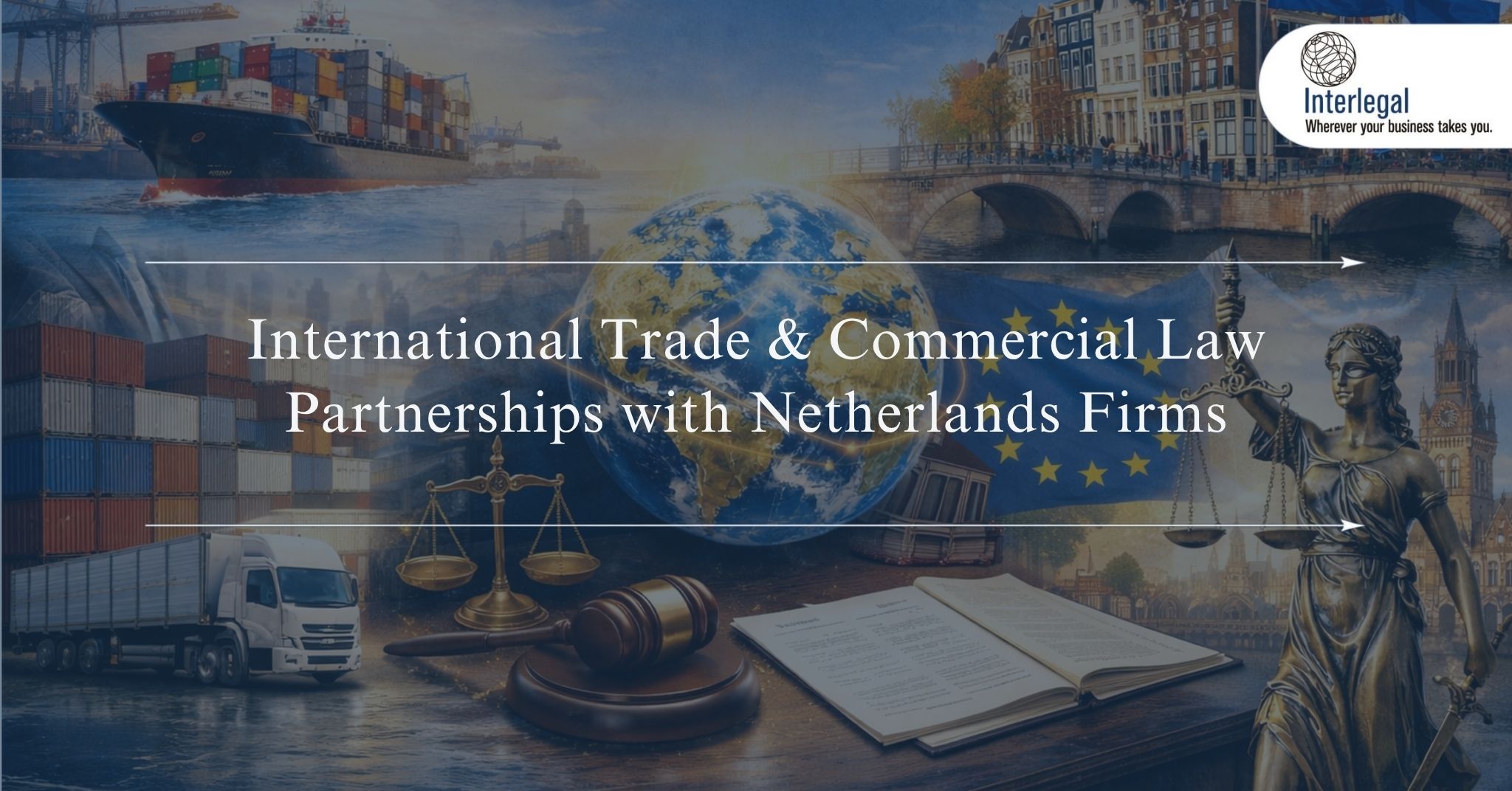
The question is answered by the Netherlands in an interesting and unique way, owing to its positioning at the heart of Europe and the presence of top-tier and world class ports like Rotterdam and Schiphol Airport. The presence of these beneficial factors has led the way to Netherlands becoming a key gateway for international commerce.
Dutch law firms and international lawyers network in Netherlands play a crucial role in facilitating trade, resolving disputes, and structuring partnerships that comply with EU and global standards.
Partnerships focusing on international trade and commercial law with firms operating in the Netherlands are becoming increasingly important for entities engaged in cross-border trade. These commercial relationships need to be compliant with EU regulations and incorporate effective global disputes resolution mechanisms. The strategic location and the strong and robust legal system offered by the Netherlands has made it a hub for international commercial law firms and attorney networks that support global trade.
Regulatory Landscape in the Netherlands
- Civil Law System: The robust legislative framework and systems have led to the Netherlands following a civil law framework, with emphasis on well drafted and codified statutes rather than a system dependent solely on case precedent. This framework, harmonized with EU legislation, leaves very little room for uncertainty and reinforces predictability in commercial transactions.
- EU Trade Rules: It is mandatory for Dutch firms to ensure compliance with EU directives and regulations on customs, competition, and trade sanctions. Key components of cross-border trading such as how goods move across borders, fair competition, and restrictions on certain countries or entities are regulated and governed by these rules. Given the Netherlands is the hub of international trade and at the same time it is also a major gateway into Europe, firms offering cross border trade law services are essential for businesses seeking smooth market access
- Global Standards: The involvement of organizations like the ICC Netherlands, ensures and continuous, harmonious and meaningful contribution by Dutch firms towards sculpting and shaping international trade law. Their active involvement also ensures that global standards in arbitration and dispute resolution are at all times taken into account while devising strategies and policies for cross-border trading.
This regulatory environment makes Dutch international commercial law firms attractive partners for businesses seeking compliance and operational efficiency.
Commercial Law Partnerships
Commercial law partnerships between Dutch firms and global counterparts are built on:
- Expertise in EU law: The in-depth and detailed knowledge of European Union legislation such as competition law, customs regulation, and trade sanctions, brought by Dutch firms is not only highly valuable but also irreplaceable. Entities entering or operating within the EU market expect efficient services from firms that help them remain compliant with rules which are otherwise complex to follow and abide with.
- Cross-border trade law services: Partnerships often focus on cross-border trade law services, to ensure that the most essential aspects of such international trade are covered. Import/export compliance, logistics, and customs disputes are at the centre of any cross-border business and in order to keep the engagements smoothly afloat, it is essential that these factors are catered to. Dutch firms, given the country’s role as a major European gateway, are well-positioned to advise on tariff classifications, supply chain regulations, and dispute resolution mechanisms.
- Joint ventures and mergers: Dutch firms understand and accept the importance of joint ventures and mergers with foreign entities. This helps them advise on cross-border business relationships and transactions that span across multiple jurisdictions. Their ability to coordinate with global partners ensures that transactions meet both EU and international standards. This is particularly important in industries like logistics, energy, and technology, where mergers often span several continents.
Such partnerships strengthen the international attorney network in Netherlands, enabling firms to provide seamless services across continents.
Ethical and Strategic Concerns
- Transparency: Firms operating in Netherlands need to ensure that their clients participate in fair competition and comply with anti-corruption laws maintaining abidance with both EU and international standards of transparency.
- Data Confidentiality: Many of the cross-border dealing involve exchanging sensitive and confidential data leading to the need of protecting such sensitive trade information in cross-border deals.
- Fairness in Arbitration: In order to maintain confidence in the dispute resolution process, it is important for Dutch firms to act as neutral arbiters in international disputes.
Best Practices for Partnerships
International trade law firms working with Dutch partners adopt:
- International trade law firms working with Dutch partners establish internal compliance policies that align closely with EU trade rules. These policies ensure that every transaction meets regulatory standards, reducing risks of penalties or disputes.
- Dutch firms, as a matter of policy, habitually and regularly provide dedicated and specialized training programs for lawyers, helping them become experts on customs procedures, sanctions regimes, and arbitration practices. This enables legal teams to equip themselves with the knowledge, skill and knowhow needed to handle complex cross-border trade law services effectively.
- Implementation of audit trails that document decisions and processes in cross-border transactions helps the firms to maintain accountability and transparency which builds long term trust and confidence. These records not only enhance transparency but also serve as evidence in case of regulatory reviews or disputes.
Common Partnerships
- Port and Logistics Matters: As discussed above, given the Netherlands’ position at the heart of Europe, it acts as a major gateway resulting in situations where law firms often find themselves advising their clients who may be engaged in issues related to customs and logistics. In such situations, collaborations with international partners who hold a certain expertise in these areas can help businesses manage regulatory, statutory and industry complexities more effectively.
- Sanctions and Contractual Adjustments: Given EU sanctions are not static and may fluctuate depending upon the global trends, local requirements and regulatory needs, the entities operating within the EU market need to be ready to adapt according to such oscillating sanction regimes and may frequently require to revisit contracts and trade arrangements. Networks of international commercial law firms in the Netherlands are well placed to support businesses in adapting to these evolving requirements.
- Cross-Border Transactions: The involvement of multiple cross-border entities in mergers, acquisitions, and joint ventures that span multiple jurisdictions inevitably requires coordinated legal advice from experts from the respective jurisdictions with knowledge on various aspects of such engagement. Without strong alignment amongst the experts advising on such issues and the entities participating in the cross border businesses, such transactions can end being riddled with delays and complications, underscoring the value of commercial law partnerships and attorney networks in the Netherlands.
Future Developments
- Digital Trade: Dutch firms are preparing for blockchain-based trade documentation.
- Sustainability: Climate-related trade regulations will require new legal expertise.
- Expanded Networks: The international lawyers network in Netherlands are likely to expand further, strengthening global collaboration.
Practical Checklist for Law Firms
- Identify reliable Dutch partners with EU expertise.
- Join an international attorney network in Netherlands for broader reach.
- Establish compliance protocols for customs and sanctions.
- Invest in digital tools for trade documentation.
- Maintain transparency and ethical governance in partnerships.
Conclusion
The Netherlands stands as a strategic hub for international trade law firms and commercial law partnerships. By joining an international law firm network in Netherlands, legal experts and firms can expand their reach, enhance compliance, and deliver cross border trade law services more effectively. For organizations like Interlegal, fostering these partnerships ensures that global trade continues to thrive under trusted legal guidance.
FAQs
Q1: Why are Dutch law firms important in international trade?
Because of their expertise in EU law, strategic location, and strong international networks.
Q2: What services do international commercial law firms in the Netherlands provide?
They offer customs compliance, arbitration, mergers and acquisitions, and dispute resolution.
Q3: How do commercial law partnerships benefit global businesses?
They provide seamless cross-border legal services, ensuring compliance and reducing risks.
Q4: What is the role of international attorney network in Netherlands?
It connects law firms globally, enabling collaboration on complex trade and commercial cases.