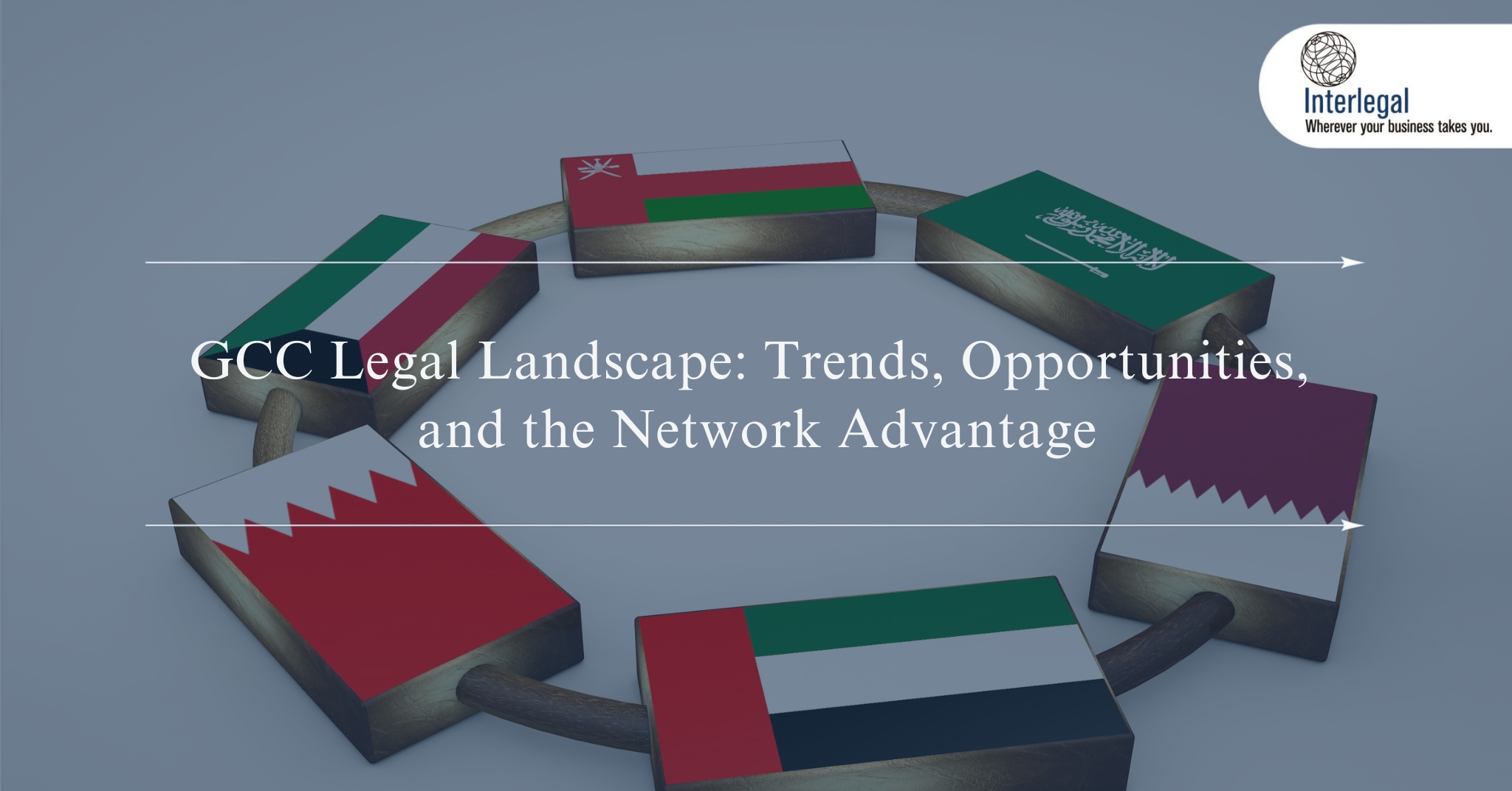
The legal landscape across the Gulf Cooperation Council (GCC) is rapidly evolving. In recent years, GCC countries have undertaken sweeping legal reforms and regulatory updates, driven by ambitious national visions and a push to diversify economies beyond oil. From Saudi Arabia to Oman, governments are updating laws on investment, corporate governance, data protection, and more, creating a dynamic environment for businesses and their advisors. At the same time, cross-border commercial activity in the region is rising sharply, meaning legal matters often span multiple jurisdictions. For law firms operating in the GCC, this presents a dual challenge. First, to stay on top of fast-changing local laws in each country and second to effectively service clients whose needs increasingly stretch across the entire region and beyond.
In this context, international legal networks are emerging as a strategic asset. They offer a platform for independent law firms in different countries to collaborate, share expertise, and support clients across borders.
GCC Legal Landscape: Regional Trends and Reforms
The six GCC states (Bahrain, Kuwait, Oman, Qatar, Saudi Arabia, and the United Arab Emirates) each maintain sovereign legal systems. However, common themes are shaping a regional legal narrative. Below we outline several overarching trends and recent reforms that are redefining business law and legal practice across the GCC:
Economic Diversification and Foreign Investment Laws:
Spurred by long-term visions (such as Saudi Arabia’s Vision 2030 and Oman’s Vision 2040), GCC governments are introducing investor-friendly legal frameworks to diversify their economies. For example, Saudi Arabia has rapidly updated laws governing foreign investment, company formation, and commercial transactions in line with Vision 2030 goals. The Kingdom’s new Companies Law and investment regulations permit 100% foreign ownership in many sectors, streamlining what used to be restrictive joint-venture requirements. Similarly, the UAE has removed most foreign ownership caps outside free zones, and Oman’s Foreign Capital Investment Law now allows wholly foreign-owned companies in most industries. These reforms collectively aim to attract international investors and encourage regional and cross-border commerce.
A recent Chambers Global report notes that Saudi Arabia’s reform agenda explicitly seeks to enhance foreign direct investment (FDI) and foster growth in non-oil sectors. Law firms in the region are adapting by bolstering corporate advisory services and guiding clients through new business set-up procedures, licensing requirements, and compliance standards under these modernized laws.
Modernizing Commercial and Financial Regulations:
Across the GCC, commercial laws are being modernized to match global standards. For instance, Saudi Arabia overhauled its Commercial Agencies Law in 2022–2023 to introduce greater transparency and flexibility for distribution agreements. Financial sector laws are also evolving – the UAE and Bahrain have pioneered fintech sandboxes and crypto asset regulations, and Saudi Arabia issued new bankruptcy and secured transactions laws in recent years to facilitate lending and corporate restructuring. Meanwhile, competition law enforcement is on the rise region-wide, with all GCC states now having antitrust statutes. There is even discussion of unified competition policies at the GCC level. These changes reflect a broader trend of GCC jurisdictions aligning their business laws more closely with international best practices, making the region more accessible to global commerce. Law firms must keep abreast of these developments to counsel clients effectively; participation in networks allows firms to exchange updates on regulatory changes in each jurisdiction, ensuring no country’s new law catches them off guard.
Taxation and Compliance:
Traditionally, the Gulf was known for tax-free environments, but that is changing. Value-added tax (VAT) has been implemented in Saudi Arabia, the UAE, Bahrain, and Oman (at a 5% standard rate in most cases, with Saudi later increasing to 15%). The UAE has also introduced a federal corporate tax (effective 2023) for the first time, signaling a shift toward a taxed corporate environment. Qatar and Kuwait are expected to follow suit on VAT or other taxes under a GCC-wide framework. Alongside taxation, robust compliance laws are emerging: all GCC states have strengthened anti-money laundering (AML) regimes in line with FATF standards, and privacy laws are gaining traction. Notably, Saudi Arabia’s updated Personal Data Protection Law (PDPL) came into partial effect in 2023, prompting companies across the region to reassess data practices and privacy compliance.
These new compliance burdens mean clients need sophisticated legal guidance on tax registration, reporting, and regulatory adherence across multiple countries, a service local firms can enhance by leveraging collective know-how from their international network peers who have dealt with similar laws elsewhere.
Labor Law Developments and Workforce Localization:
One of the most visible regional themes is the drive to increase national workforce participation. Policies like Saudisation in Saudi Arabia, Omanisation in Oman, Emiratisation in the UAE (and similar programs in Kuwait, Qatar, and Bahrain) impose quotas or incentives for hiring local nationals in the private sector. While each country’s scheme has unique features and target sectors, the overall trend has become a defining characteristic of GCC employment law. Governments regularly issue updates expanding the roles reserved for citizens or raising localization targets.
For example, Saudi Arabia’s Nitaqat program classifies companies by their percentage of Saudi employees, with compliance tied to benefits or penalties. Oman has designated certain professions for Omanis and offers levies on expatriate hires. The UAE has recently begun phasing in Emiratisation requirements for employers above certain size thresholds. These initiatives align with broader economic goals (reducing expat labor reliance and developing local talent), but they require businesses, and by extension their legal advisors, to carefully manage human resources compliance.
Law firms are increasingly called upon to advise companies on meeting localization rules, obtaining work visas, and adjusting employment policies. Notably, even law firms themselves are adapting internally: international firms operating in the region are adjusting to Emiratisation and Saudisation mandates, reshaping how they structure and hire their own teams. While workforce nationalisation is not the only aspect of labor law, it underscores the need for counsel well-versed in local labor regulations across the GCC. Through an international network, member firms can share strategies on handling these employment laws, ensuring that best practices in one jurisdiction inform solutions in another.
Judicial Reform and Dispute Resolution:
Strengthening the rule of law is another cornerstone of GCC legal development. Countries are investing in their judicial systems and introducing specialized courts to improve efficiency. For instance, Oman’s new Investment & Trade Court, slated to launch in 2025, will focus on commercial and investment disputes, signaling a push to reshape the dispute resolution landscape in line with investor expectations. Saudi Arabia and the UAE have established specialized commercial courts and digital justice platforms (like Saudi’s Najiz portal for e-litigation) to expedite case handling.
Arbitration is also gaining prominence as a preferred mechanism for international business disputes: all GCC states are parties to the New York Convention on arbitration awards, and centers like the Saudi Center for Commercial Arbitration (SCCA) in Riyadh, the Dubai International Arbitration Centre (DIAC), and the Bahrain Chamber for Dispute Resolution (BCDR) are active. Moreover, many GCC jurisdictions have modern arbitration laws modeled on the UNCITRAL Model Law (e.g. Bahrain and Qatar updated theirs in the 2010s, and Saudi Arabia did so in 2012), enhancing arbitral procedures and enforcement. The region is thus becoming more arbitration-friendly and globally connected in dispute resolution.
For law firms, this opens opportunities to represent clients in cross-border disputes, but it also demands familiarity with both local court systems and international arbitration norms. Having a network of trusted partner firms means a litigator in Kuwait can readily coordinate with colleagues in the UAE or Saudi Arabia when dealing with multi-jurisdictional enforcement of judgments or arbitral awards, providing clients a cohesive strategy across courts.
Taken together, these regional developments depict a GCC legal environment in transformation, one that is more complex, internationally aligned, and fast-moving than ever before. Each country retains its unique legal identity (for example, Kuwait’s laws and legal culture differ from Bahrain’s or Oman’s), yet the overall trajectory is toward modernization and regional convergence on global standards. Importantly, no single regulatory regime governs the GCC; businesses and their lawyers must navigate six separate sets of laws. Next, we consider what this means for law firms and how they can capitalize on these trends.
Challenges and Opportunities for Law Firms in the GCC
For law firms operating in or across GCC jurisdictions, the evolving landscape presents both significant opportunities and strategic challenges. Here are some key considerations for firms in the region:
Navigating Diverse Legal Systems:
Despite cultural and economic linkages, the GCC is not a monolithic legal zone – each state has its own legislation, regulatory bodies, and court procedures. A merger or commercial contract might trigger different requirements in, say, Saudi Arabia versus Qatar. For example, foreign ownership limits or licensing steps can vary widely by jurisdiction. This diversity means law firms must either develop in-house expertise country-by-country or partner with external counsel to cover gaps. Firms that successfully coordinate multi-jurisdiction advice have a competitive edge as clients increasingly pursue region-wide ventures.
Keeping Pace with Regulatory Reform:
The torrent of new laws (from data protection rules to new tax codes and investment laws) requires lawyers to continuously update their knowledge. There is a premium on specialized expertise in areas like fintech regulation, ESG compliance, or competition law which are relatively nascent in the Gulf but growing rapidly. Firms that cultivate subject-matter experts and share insights (through internal training or inter-firm knowledge exchanges) can position themselves as leaders in these emerging fields. In an international network, member firms often exchange alerts and updates on legal changes, helping each other stay ahead of the curve. This kind of information sharing is invaluable when a client’s question crosses into a domain that has recently changed (for instance, a new data privacy requirement in Bahrain or an updated commercial code in Kuwait).
Cross-Border Client Service:
Many corporate clients in the GCC operate in multiple countries or have supply chains and investments that span the region. They expect their legal advisors to handle cross-border matters seamlessly. Modern clients look for seamless multi-country support, legal guidance coordinated across jurisdictions without having to separately hire firms in each country. They also value “local insight with global coordination”, meaning a solution that blends understanding of local law with a broader strategic view. Delivering this level of service is challenging for any single firm. It requires either a regional presence (offices or correspondents in multiple GCC states) or a tight cooperation model.
International legal networks provide an answer here: member firms can jointly serve a client, each bringing local know-how while communicating as one team. From the client’s perspective, this feels like dealing with one firm that has a multi-country footprint, which meets the expectation of unified service. For GCC law firms, being part of such a network enables them to confidently pitch for cross-border deals – for example, advising a company on an M&A deal that involves entities in Dubai, Riyadh, and Muscat, by forming an ad-hoc team of lawyers from network offices in the UAE, Saudi Arabia, and Oman.
Meeting Localization and Talent Needs:
As discussed, the push for hiring national lawyers (e.g. Saudi or Emirati lawyers) means firms must balance compliance with these policies and maintain a diverse talent pool. There is high demand for bilingual lawyers (fluent in Arabic and English) who understand local law and international practice. Recruiting and retaining such talent is an ongoing concern.
By connecting with other firms in the region, a law firm can share strategies on training programs, secondments, and even exchange personnel to build capacity. Furthermore, a network affiliation can be attractive to young lawyers seeking exposure to international work without leaving their home country practice. It offers opportunities to collaborate on global matters and learn from foreign colleagues, which can aid retention and skill development.
Competition and Collaboration:
The entry of large international law firms (especially into Saudi Arabia and the UAE) introduces competition for high-end work. Local and mid-sized firms might risk losing clients to bigger, global players. However, being part of a well-regarded legal network effectively multiplies a firm’s capabilities without the overhead of physical expansion. It allows a firm to market itself as the exclusive local partner of a global alliance, which can appeal to clients who would otherwise consider a multinational firm.
In addition, networks create a pipeline for referrals – member firms send each other client matters that require local handling, which can become a significant source of new business. Rather than viewing globalisation purely as competition, GCC firms can leverage collaboration through networks to win work that comes from outside and to jointly service mega-projects (such as infrastructure or energy projects involving multiple countries). This collaborative approach turns the presence of international players into an advantage: a member firm in one country can be the go-to referral partner for a foreign firm (via the network) instead of an outsider firm setting up its own shop locally.
In summary, GCC law firms that adapt to the region’s legal transformation stand to gain substantially. The opportunities, advising on foreign investments, compliance in new regulatory areas, participating in transformative projects, and handling multi-billion dollar disputes, are growing as the Gulf economies expand and modernize. Yet no firm is an island; the scope and speed of change make it difficult to cover all bases alone. This is where international alliances come in. In the next section, we examine how joining an international legal network can help law firms meet these challenges and capitalize on the opportunities across the GCC.
The Power of International Legal Networks in the GCC
Given the intricate patchwork of laws and the cross-border nature of many deals in the GCC, belonging to an international legal network has become a strategic boon for regional law firms. Such networks connect independent firms under a framework of mutual collaboration and trust, without compromising their autonomy. For GCC firms, joining a network like Interlegal provides two crucial advantages:
Seamless Cross-Border Collaboration:
An international network effectively functions as an extended platform to serve clients beyond one jurisdiction. Member firms in different countries can easily form integrated legal teams to handle a matter, each firm contributing local expertise while working in sync. For instance, consider a client needing advice on a cross-GCC merger: corporate lawyers in Riyadh can coordinate due diligence in Saudi Arabia while partners in Dubai navigate UAE merger controls, and yet another team in Muscat addresses Omani licensing – all working together through network channels. This ensures consistent quality and efficient communication, as network partners are accustomed to cooperating.
According to a legal insight by an M&A advisory firm, coordinating GCC-wide due diligence through in-region counsel is a practical strategy for successful cross-border deals. Essentially, the network serves as a built-in referral and teamwork system, so that clients receive one-stop service across borders. This not only makes life easier for clients, but it also helps member firms retain clients who might have operations in multiple countries – instead of losing the work to a competitor with a regional office, the firm can handle it via trusted colleagues in the network.
Shared Knowledge and Best Practices:
In a time of rapid legal change, the value of information cannot be overstated. Networks facilitate continuous knowledge exchange among member firms. Through regular communications, conferences, and online platforms, lawyers share updates on new laws, discuss how to interpret regulatory developments, and benchmark practice management ideas. Member firms in 45+ countries (across 6 continents), as Interlegal currently has, bring a vast repository of jurisdictional expertise to the table. For GCC firms, this means having at their fingertips a global knowledge base – whether it’s understanding how a data protection law in Bahrain compares to Europe’s GDPR, or learning how another country’s law firms implemented an ESG compliance program for clients.
This collective wisdom enables each member to provide more comprehensive advice, anticipating issues that a purely local firm might overlook. Moreover, by participating in a network’s webinars or working groups, Gulf lawyers can enhance their skills in niche areas (say, international arbitration or cross-border tax structuring) which are increasingly relevant as the region internationalizes. In short, the network acts as a professional development catalyst and a real-time legal intel system, which is especially valuable when GCC regulations are in flux.
Beyond these practical benefits, being part of an international network carries reputational weight. It signals to the market that a firm is globally connected and vetted by peers. As observed in the context of Jordan (which is analogous to GCC firms), membership in a reputable network assures multinational clients that the firm has international connections and support, and can coordinate with partners in key foreign markets.
This can be a deciding factor for a client choosing local counsel in, say, Qatar or Kuwait for a project – the firm that can demonstrate network backing may win confidence over one that cannot. In a region where large-scale projects often involve foreign investors, joint ventures, and cross-border finance, this credibility boost is highly advantageous for business development.
Interlegal: A Global Network for Local Success
Among international legal alliances, Interlegal stands out as a longstanding and dynamic network geared towards enhancing the capabilities of independent law firms. Founded in 1989, Interlegal today comprises dozens of member firms around the world, including in the Middle East, Europe, Asia, and the Americas. It is not a franchise or a merger; rather, each member remains an independent entity, but with access to the “wide resources of peers worldwide” that Interlegal provides. For GCC law firms, joining Interlegal means gaining an immediate global reach while retaining their autonomy and local identity.
How does Interlegal add value to member firms?
Firstly, through trusted referrals and client sharing. Interlegal’s model encourages firms to refer clients to one another whenever a matter touches another jurisdiction. There is a strong emphasis on personal relationships and trust. Members often meet at annual conferences or virtual forums, building rapport that translates into smooth collaboration on cases. As a result, a member firm in Bahrain could receive a referral for a client transaction coming from a partner firm in France or India, and vice versa. This referral pipeline can become a significant source of new work.
Secondly, Interlegal provides collaborative tools and knowledge-sharing opportunities. Members regularly contribute to joint publications, legal guides, and updates. For example, an Interlegal firm in the UAE might share its experience on the latest fintech regulations, benefiting partners in other countries who have clients investing in the Emirates. The network also organizes practice groups and workshops, so that lawyers across firms can brainstorm solutions to common challenges (be it adapting to new labor laws or handling COVID-19 legal impacts).
Importantly, Interlegal maintains a standard of quality and ethics that all members uphold. This ensures that when a GCC firm refers its valued client to another Interlegal firm abroad, it can trust that the client will receive professional, prompt, and expert service (and vice versa when foreign firms send work into the Gulf). In essence, Interlegal extends a GCC firm’s capabilities beyond its home borders: your firm can confidently say “yes” to a client inquiry about laws in another country, knowing you have a partner on hand to assist.
Conclusion
As the GCC’s legal environment becomes more sophisticated and globally integrated, law firms in the region find themselves at a crossroads. On one hand, they must manage the intricacies of local laws – which continue to develop in complexity – and on the other hand, they must meet the expectations of clients whose business and legal needs transcend borders. The holistic view of GCC legal practice reveals a region brimming with opportunities: new investments, regulatory reforms creating fresh areas of practice, and major projects driving demand for high-end legal counsel. Yet it also underscores a clear message: collaboration and knowledge-sharing are key to turning these opportunities into sustained growth.
International legal networks provide an elegant solution by connecting jurisdictional dots. Instead of operating in isolation, a law firm that is part of a network like Interlegal can leverage collective strength – whether it’s tapping a colleague in another country for quick advice, jointly pitching for a cross-border deal, or learning how others adapted to a law change that your country is now implementing. For GCC firms, this means they can confidently serve clients region-wide (and globally) without sacrificing the boutique, client-focused service that is their home advantage. They remain independent, yet never alone.